

Labour commits to ELM, but is silent on farming budget
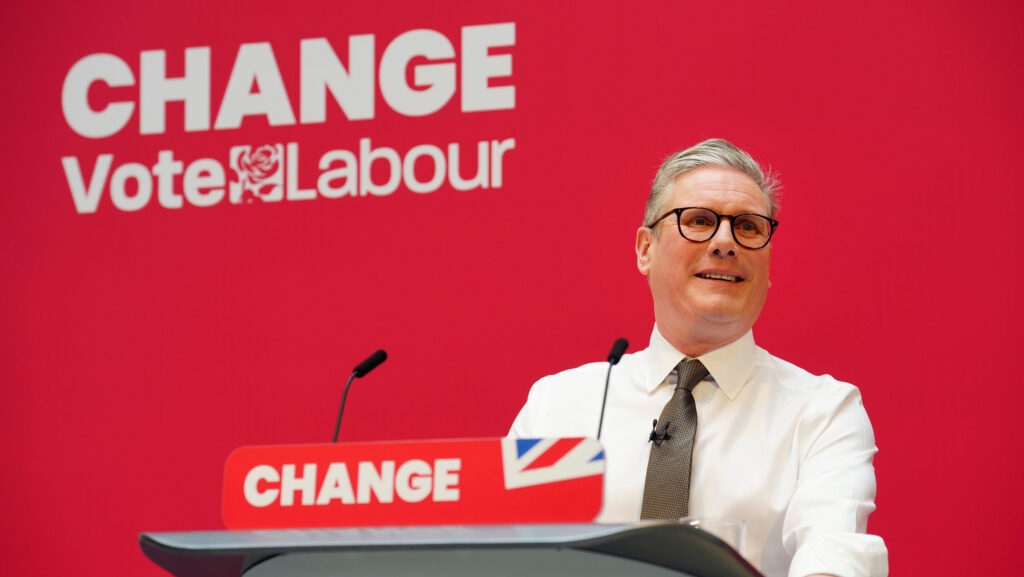 Labour Party leader Sir Keir Starmer speaks at the manifesto launch © John Super/Associated Press/Alamy Stock Photo
 Labour has pledged to “cut through Tory bureaucracy” that has blocked farmers from receiving hundreds of millions of pounds of funding, as the party launched its general election manifesto on Thursday 13 June.
Sir Keir Starmer’s party has committed to continuing the government’s Environmental Land Management (ELM) scheme, but there is no mention of the farming budget in its general election manifesto.
A Labour Party spokesperson said: “We have been absolutely clear that we will not make any unfunded costing going into this election. But we are committed to the Environmental Land Management schemes.
See also: Labour and Conservatives ramp up battle for rural votes
“The Conservative government has said it would increase the farming budget by £1bn over the next parliament, but it can’t even spend the current budget. It’s got £200m worth sitting in the coffers of the Treasury.
“We’ve said that we would reduce the red tape in the schemes to ensure that the money that’s being underspent gets out the door and into the pockets of farmers.”
Spending review
The spokesperson added that if Labour wins the election, it will not know how much money it can allocate to ELM and farming until it carries out its first spending review.
Unlike the election manifestos for the Conservatives and the Liberal Democrats, there is no bespoke section of food and farming in Labour’s manifesto.
But the Labour spokesperson insisted that food and farming pledges are “littered” across its manifesto, rather than in a single section.
In a section under Trade, there is a pledge to protect British farmers in trade deals and stop them from being undercut by low welfare and environmental standards.
Labour says it would seek to “rebuild” relationships with the European Union to improve trade and investment with the bloc.
To this end, it would seek a new veterinary agreement with the EU “to cut red tape at our borders to get British food exports moving again. However, the manifesto makes it clear there will be “no return to the single market, the customs union or freedom of movement.”
Food security
Labour says it “recognises that food security is national security”, which is why it would “champion British farming whilst protecting the environment”.
A Labour government would set a target that 50% of food in our hospitals, army bases and prisons is local or produced to high environmental standards.
The party would also introduce a land use framework “to ensure the correct balance between food and energy production, housing, and nature recovery”.
Other significant policy pledges for farming include the setting up of a new British Infrastructure Council to steer private investment in rural areas, with more broadband rollout in rural communities and electricity grids to power our growth.
The Energy section in Labour’s manifesto includes a plan to cut energy bills for farmers by switching on GB Energy, a new publicly owned energy company that will “harness clean home-grown British power”.
However, cattle farmers who are generally supportive of the Conservative government’s badger culling policy, which was introduced in 2013 to tackle bovine TB, will be dismayed that Labour plans to stop it.
Labour’s manifesto states: “We will work with farmers and scientists on measures to eradicate Bovine TB, protecting livelihoods, so that we can end the ineffective badger cull.”
The Labour spokesperson said the party’s position on badger culling had “shifted slightly”, emphasising that it would not be seeking to end culling overnight.
“We have got to introduce an eradication package for TB. The priority is rolling out vaccination and biosecurity programmes to protect farmers’ livelihoods,” said the spokesperson.
“Once we have rolled out this package, we are confident that would be enough to end the culls.”
Industry reaction
Rural organisations have cautiously welcomed Labour’s election manifesto.
Country, Land and Business Association president Victoria Vyvyan said: “Labour says its top focus is economic growth, but its manifesto is silent about how it will unlock the growth potential of the rural economy.
“It says it will support farmers by continuing the Environmental Land Management schemes, but gives no details about the agricultural budget. The manifesto supports reform of the planning system, but again, no detail is provided.
“This manifesto suggests Labour is listening, and we welcome the manner in which they have engaged with us, but much more thinking needs to be done to deliver the serious change in business environment the countryside needs.”