

Slim store margins as heavy lambs get penalised
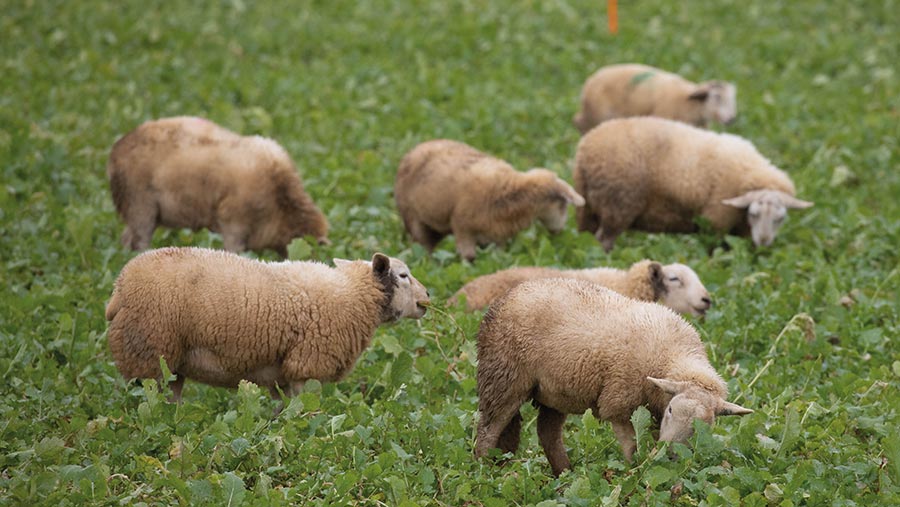 © Tim Scrivener
 An oversupply of heavy lambs in recent weeks has followed flatlining prime prices and kind winter weather.
Many finishers were charged with paying over the odds in November store lamb sales, and have held on to lambs longer this year, desperate for a sharp rise in hogg trade.
Store lamb rings saw red-hot trade in late 2021, partly because more arable and dairy farmers played the store market themselves, auctioneers say.
This ensured strong prices in the store ring, with more lambs carried into 2022. This, in turn, resulted in prime lambs being slightly undersupplied late last year, with trade lifting from a September low of 218p/kg to 286p/kg at the end of the year.
See also: Prime lambs firm after plummeting £30-£35 a head
Prime lamb prices were 55-60p/kg down on this level during the same period in 2020, when cautious farms offloaded lambs early in fear of a no-deal Brexit.
Now, a slightly subdued hogg trade has seen prices hover at about 265p/kg. Patient finishers have seen hoggs reach high weights with more milk and drier weather than normal.
Defra’s February slaughter figures show average carcass weights are significantly higher. Farm shop and catering demand is good, but not sufficient to reward all the heavy lambs being brought to market, auctioneers say.
Ayr
This has certainly been the case at Ayr where, like at many markets, weight has not “paid” since Valentine’s Day.
Drew Kennedy, auctioneer at Ayr for Craig Wilson Livestock, said he had seen Blackface hoggs coming off wintering grass weighing 3-4kg more this year.
“Normally they would be 40-41kg, but this year they’ve been more like 44-45kg,” said Mr Kennedy.
Monday’s (28 March) entry saw 1,546 lambs on the SQQ and a further 1,014 lambs marketed over 45.5kg. “As the weight goes down, the price per head doesn’t really move,” he said.
Mr Kennedy added that 52kg lambs had grossed £120-£127 on Monday, 45kg lambs had made £117-£120 and some good 42-43kg lambs made almost as much.
He said many store lambs had not made much margin this year, and in some cases would have just broken even. This was particularly the case for lambs bought in November, when the prime price was good.
“The autumn prime price sets the tone for the store lambs every year, and we were getting £130 or more for lambs in September and October,” he said. “People assumed [this] would mean hoggs at £150-£160 in the spring.
“Some stores have left a big margin, though. The early-bought ones in August and September that grew well might have cost £80 or £82, and they made £130 in October.”
Market Drayton
Trade had been slower than store finishers would like at Market Drayton, said Mark Jones, director and sheep auctioneer at Barbers, but now the waiting game was coming to an end,
“There should be enough hoggs in the pipeline to meet Easter demand,” Mr Jones told Farmers Weekly. “Farmers are wanting to get the last lambs sold now, as there are crops to get in and plenty of spring jobs to do.”
He said hogg trade had improved a touch, with Easter and Ramadan lifting demand. This had allowed the market to sell almost 900 more lambs last week than three weeks earlier, for a stronger average of 261p/kg, compared with 256p/kg.
Export market
Export trade has also seen heavy lamb prices struggle in recent weeks, as finishers look to increase value on lambs bought for £100 four months ago.
Midlands-based Gordon McWhirter of Meadow Quality said 50kg was roughly the cut-off point for demand.
“At this time of year for export weights up to a 22kg carcass, it’s 49-50kg lambs that are needed,” he said. “Earlier in the season nearer 42kg will do.”
Mr McWhirter added that demand from Europe was still strong, but buying patterns had changed recently.
He said he had heard reports of French processors sourcing less British product and using more from within the EU.
Eurostat figures show sheep slaughter numbers were up 22.5% on the year in 2021 in Germany. Polish, French and Spanish production was also higher last year than in 2020, but overall Europe’s sheep flock is contracting.
Outlook
- The trade says hoggs will supply the bulk of Easter lamb
- A late Easter Sunday – 17 April – might drive trade during a quiet time halfway through Ramadan (2 April-2 May). Ramadan is the Muslim period of daytime fasting and nighttime feasting
- A couple of weeks in mid-April could see slow hogg trade if consumer demand does not improve
- Start talking to auctioneers about Qurbani trade in early June to plan marketing strategies, as Eid al Adha is 9 July this year