Crop Watch: Hybrid barleys approaching T0 in South-West
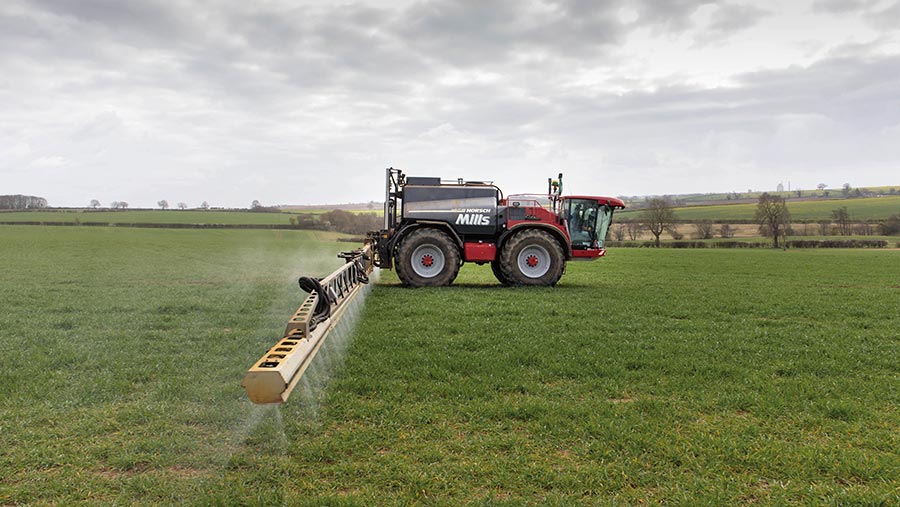 © Tim Scrivener
 Some cereal crops have already received their early nitrogen fertiliser applications, and barleys are starting to show the benefits.
However, high fertiliser prices are denting some of the optimism, especially as the nitrogen fertiliser savings talked about in forward crops of oilseed rape may not materialise, given that pigeons have feasted heavily, knocking back some crops.
South: Iain Richards
Agrii (Oxfordshire)
All our second and later-drilled wheats have had their first nitrogen, but we’ve been in no rush to get it onto earlier-sown crops.
With so much potential in them, most nitrogen bought at reasonable prices and N-mins not exceptionally high, we aren’t cutting N rates in most cases. Especially as wheat values are so firm and protein is likely to be worth a lot to millers if spring nitrogen economies are too extensive.
See also: Two new fungicides to fight septoria in wheat grower’s plans
We are acutely aware there is unlikely to be any cheap fertiliser next season and those supplies may be restricted, so we are taking the breathing space to try out a number of approaches to improving nitrogen use efficiency that have shown particular promise in Agrii trials.
These include using inhibitors with liquid urea/ammonium nitrate, a stabilised fertiliser in place of solid ammonium nitrate, and polysulphate to better balance N with fresh available potash and magnesium as well as sulphur.
In doing this we are particularly conscious that, as well as being very dry, last April gave us more than 15 consecutive frosts, making it crucial that there is sufficient available nutrition in the ground early enough.
Any repeat of this may calm down disease cycling, but in our experience it won’t lead to the sort of leaf loss we see from decent winter frosts.
So the substantial reservoir of septoria we have in the base of most crops is driving our disease management thinking, as is the experience of those who really struggled to control yellow rust wherever it got away last season.
T0 options
Among the limited T0 options we have these days for varieties like Zyatt that need the most support, we will be sticking with the bromuconazole/tebuconazole co-formulation, with or without folpet, that we have found especially effective.
At the other end of the variety spectrum, we were very impressed with our results from the elicitor Iodus (laminarin) on Extase last season. We will be making use of this and a number of other promising biologicals at T0 on our more robust wheats.
Alongside the low temperature-active chlormequat we have long used at T0, our more forward wheats will be getting a low rate of trinexapac here, as well as at T1 for greater consistency in a season in which crops receiving early N are already moving strongly.
While we were looking forward to some useful nitrogen savings with our OSR at the turn of the year, horrendously large flocks of pigeons have changed everything. With many green area indices of over 2.0 coming into January down to less than 1.0 by last month, all our crops have had a first dose of 70kg/ha.
The mild winter and pre-emergence limitations of companion cropping have also meant we’ve had to work harder-than-ever on our broad-leaved weed control this spring.
On the bright side, though, our generally later-sown crops have fewer cabbage stem flea beetle larvae than earlier sowings and the sort of rooting and collar widths that should enable them to bounce back well as they move into stem extension. They are also nice and clean.
East: Becky Finbow
Agrovista (Norfolk/Suffolk)
What an interesting year it has already been for the agricultural sector.
It’s officially spring, a time of optimism, but unfortunately it doesn’t feel much like it, what with record fertiliser prices and the steep price increase in fuel.
Autumn-drilled cereals look very well in the East, with lots of potential heading into the spring. Pre-emergence herbicides have done a brilliant job in controlling weeds, in particular tricky blackgrass populations.
This has allowed reduced reliance on post-emergence sulfonylureas, saving some much-needed pennies.
Where blackgrass has managed to survive, predominantly in clods, an application of Proverb (iodosulfuron + mesosulfuron + thiencarbazone) has been recommended and is planned for application soon when grassweeds are actively growing.
Virus yellows
Another conversation being had in the East is about beet seed. The Rothamsted Virus Yellows Forecast has confirmed that 68.9% of the sugar beet crop would be expected to show symptoms in the absence of control, well above the 19% threshold. As a result, Cruiser SB (thiamethoxam) treatment will be applied to seed this season.
Many farmers have chosen to buy treated seed and should be reminded of the essential stewardship measures that accompany the seed treatment.
The treatment will protect your crop for up to 10 weeks after drilling, allowing time for the usual measures to be implemented to get the crop to the 12-leaf stage as quickly as possible.
I couldn’t write this piece without mentioning fertiliser prices. No one could have predicted the sky-high prices the industry is currently facing and, consequently, it is a popular topic of conversation between agronomist and grower.
Applications have started here on backwards oilseed rape crops, with cereal applications likely to follow soon. The focus will be on ways of increasing fertiliser use efficiency, implementing methods such as smaller amounts across more splits and applying foliar feeds to prevent loss and improve uptake.
Other tools such as the breakeven ratio and AHDB’s fertiliser adjustment calculator are also worth looking at to quantify the overall cost and return.
West: Stephen Harrison
AICC/Southwest Agronomy (Avon)
Despite the cold snap things are starting to move down here. Winter barley is feeling the benefit of the late February applied nitrogen and sulphur.
Hybrid varieties are rapidly approaching growth stage 30 and are due for fungicides and growth regulator. Disease levels are currently low and mildew has been slowed down by the frosts.
Fungicide choice will once again be centred on prothioconazole, largely in co-formulation with an SDHI. Only varieties with a low resistance to mildew, such as Orwell, will have a specific mildewicide added.
Only the earliest drilled, most forward wheats are anywhere near growth stage 30. With the absence of chlorothalonil this season, T0 fungicides will be applied only where yellow rust is rearing its head.
Chlorothalonil was low-cost and effective, but replacement multisites are not in the same league and are hard to justify in the absence of yield-bearing leaves.
We have always selected varieties with high septoria resistance in the South West, and the absence of key actives makes this even more important. Compared with further east we have seen very little of this disease so far, even in Skyfall, which is particularly susceptible.
Early season passes in wheat will be limited to plant growth regulators and rust control where appropriate.
BYDV
Thankfully, I have seen little evidence of barley yellow dwarf virus in cereals this spring. This is a relief and justifies management decisions not to treat some crops last autumn.
The limited area of winter OSR is moving towards yellow bud. Light leaf spot levels have been high in any sample submitted, so any PGR fungicides have been geared towards this disease with the inclusion of prothioconazole with the PGR.
This is the second time I have mentioned this active in one article, a reflection of how bare the azole cupboard has become.
Spring drilling is well under way with excellent seed-beds on the lighter ground. We will need to be patient on the stronger ground.
North: Helen Dent
Hutchinsons (Cumbria)
I start this year’s crop watch with crops full of promise and the likelihood of high crop prices at harvest, so it’s likely that despite the issues around fertiliser and input prices, crops will be well looked after this year.
Last autumn we had a kind drilling season, crops went in reasonably early and we had a mild and dry autumn, with the exception of Dudley, Eunice and Franklin doing their worst.
As soil is starting to warm up, our thoughts turn to fertiliser strategies – a particular area of debate on farm at present, and fertiliser availability and price issues are likely to only get worse.
A drier winter means there are higher levels of residual nitrogen, and root systems are in general quite strong, having not sat wet all winter, as they so often do in our part of the world.
However, nitrogen is still a very responsive input and the break-even ratio is key and should take into account the high yield potential and high crop prices. Mixed farmers should also consider that bought-in feed is going to be expensive this year so the more that can be grown at home, the better.
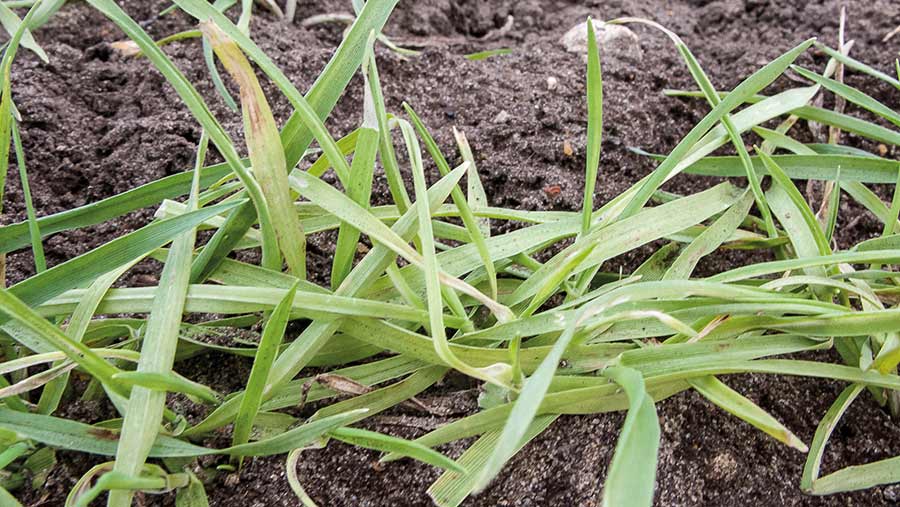
Beware of manganese deficiency in barley © Blacktorn Arable
Pigeon damage
Crops are particularly strong this spring. There were some huge winter oilseed rape crops which have had quite a bit of pigeon damage (where the pigeons have been able to land). However, unless damage has not been too severe, crops will soon recover.
Growers should not forget sulphur when considering oilseed rape fertiliser strategies – especially to make the most of expensive nitrogen applications.
Winter barley and wheat are also strong, and manganese deficiency is present across some barley crops, especially on lighter land and areas of poor consolidation. This is a sign that crops have been actively growing over the winter period, thanks to the conditions.
Manganese should be applied as soon as possible on these crops to prevent them losing tillers.
Let’s hope for a great 2022 growing season.